No Job Too Small at Pride Car Customs – Bringing a 2018 BMW X3 Back to Its Best!
At Pride Car Customs, we believe every vehicle deserves to look its best, whether it needs a complete transformation or just a little TLC. No job is too small, and we take pride in working on all makes and models, from everyday family cars to luxury vehicles.
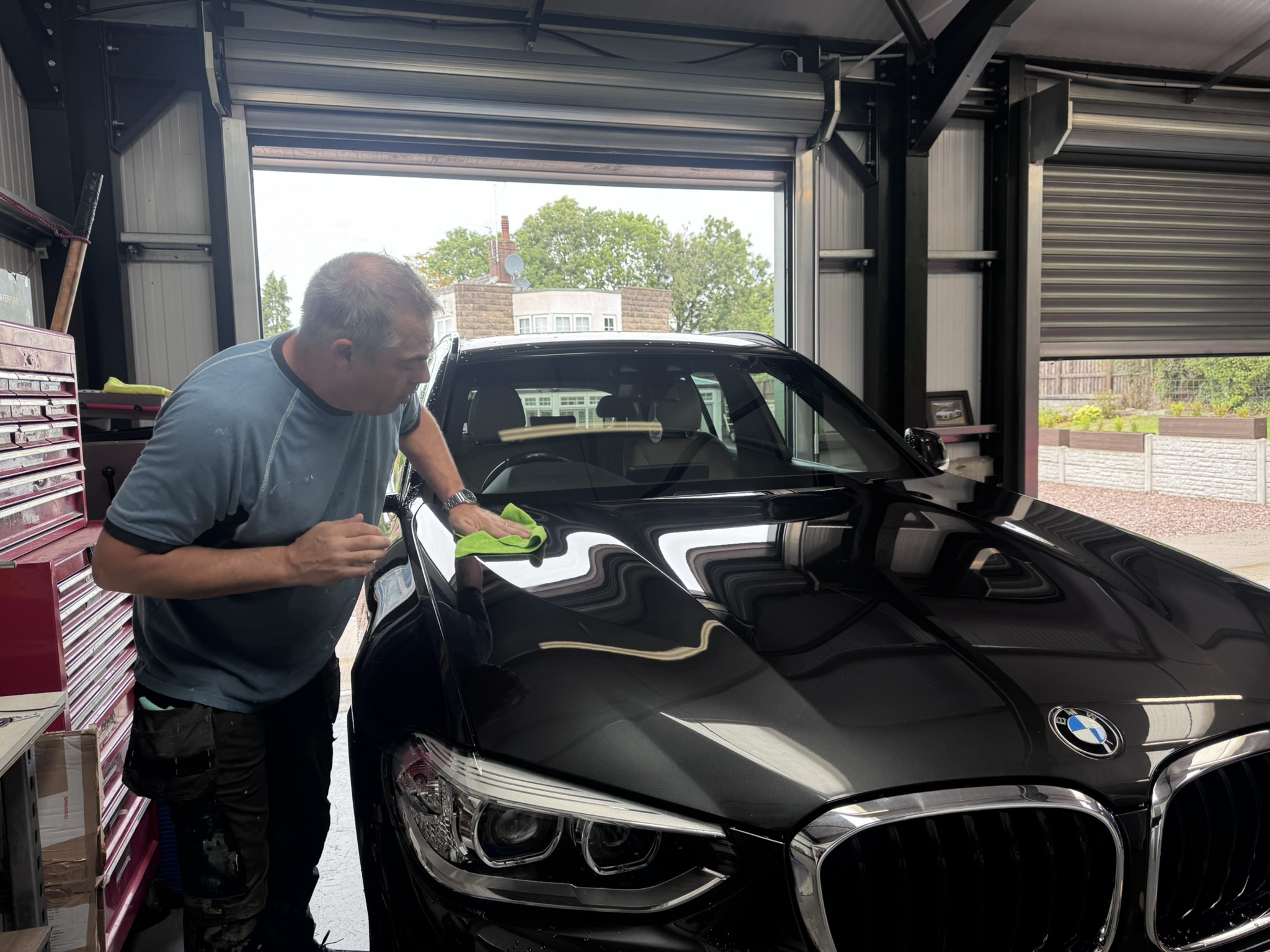
A perfect example is this 2018 BMW X3, which needed some attention to bring back its appearance without the expense of a full respray.
Not Every Car Needs a Respray!
Over time, everyday driving can take its toll on your vehicle’s paintwork. Stone chips, light scratches, swirl marks and general wear can leave even a well-maintained car looking a little tired.
But here’s something many car owners don’t realise: you don’t always need an expensive respray to make your car look fantastic again!
Sometimes, a little professional attention and the right techniques can make a remarkable difference.
Giving This 2018 BMW X3 Some TLC
For this BMW X3, our approach was all about improving the existing paintwork rather than replacing it unnecessarily.
Step 1 – Stone Chip Touch-Ups
We started by carefully touching up the stone chips using suitable matching paint. These small imperfections can really stand out, particularly on an otherwise well-presented vehicle.
By carefully filling and disguising these chips, we can significantly reduce their visibility without needing to repaint entire panels.
Step 2 – Professional Machine Polishing
Next came a thorough machine polish to help restore the paintwork’s shine and improve its overall appearance.
Machine polishing can help reduce light scratches, swirl marks and dullness, bringing back the depth and gloss that make a vehicle stand out.
Step 3 – Finishing by Hand
Finally, we carried out a careful hand polish to refine the finish and help blend the touched-up areas into the surrounding paintwork.
This final stage helps make those little stone chip repairs less noticeable, leaving the vehicle looking cleaner, fresher and much better presented.
While touch-ups won’t always be completely invisible, they can make a huge difference to the overall appearance of a vehicle at a fraction of the cost of more extensive paintwork.
Big Results Don’t Always Need a Big Job!
This BMW X3 is a great example of how a few carefully chosen improvements can make a real difference.
At Pride Car Customs, we’re not just interested in major bodywork and full resprays. We’re equally happy helping customers with those smaller jobs that can make their pride and joy look its best again.
Whether you drive a BMW, Audi, Mercedes, Ford, Volkswagen or something completely different, we’re happy to discuss what we can do for your vehicle.
Give Your Car the Attention It Deserves
Got a few annoying stone chips? Is your paintwork looking a little dull? Or perhaps you just want to freshen up your car without spending a fortune?
Get in touch with Pride Car Customs today!
We’ll be happy to take a look and discuss the best way to improve your vehicle’s appearance, without recommending unnecessary work.
Pride Car Customs – No Job Too Small, Every Detail Matters.
Comprehensive Case Report: Restoring Sentimental Value While Controlling Costs
Project Focus: Bumper Scuff Repair & Cosmetic Rejuvenation for Modern Non-Classic Vehicles Prepared by: Restoration & Repair Team
1. Executive Summary & Core Philosophy
In the automotive world, standard industry practices categorize vehicles binary: they are either high-value classics worthy of blank-cheque restorations, or they are aging daily drivers destined for the scrap heap once repair bills exceed their book value.
Our philosophy rejects this binary approach. We specialise in a rapidly growing, deeply human segment of car ownership: the sentimental non-classic.
The Sentimental Non-Classic
These are cars that are old, but not classic. They might be a 15-year-old family hatchback, a first car, or a late-model saloon passed down from a relative. Statistically and financially, they may not be worth thousands of pounds on the open market. However, they share our hearts. They represent memories, reliability, and personal history.
Our Mission: Bridging the Financial Gap
When these vehicles suffer the inevitable “scuffs and knocks” of daily life, traditional body shops often quote prices that trigger insurance write-offs or discourage owners entirely.
Our mission is to keep these pride and joys going by utilising smart, cost-effective repair methodologies. We prove that a vehicle does not need a four-figure showroom repaint to look exceptional, retain its structural integrity, and preserve its immense sentimental value.
2. Technical Case Study: Plastic Bumper Scuff Repair
To demonstrate our cost-conscious, high-quality approach, this technical report details the complete restoration of a severe bumper corner scuff on an aging daily driver. The goal was to eliminate unsightly cosmetic damage while avoiding the massive expense of ordering, painting, and blending an entirely new bumper assembly.
Phase 1: Deep Chemical Preparation & Decontamination
Before any mechanical repair can begin, the target area must be clinically clean. Failing to decontaminate plastic will result in road grime and silicone being driven deep into the substrate, causing the paint to fail later.
Degreasing: The bumper was washed with a dedicated automotive shampoo, followed by a heavy-duty, solvent-based panel wipe to strip away old waxes, road tar, and silicone tyre-shine overspray.
Masking: To keep costs down and prevent unnecessary paint texture differences across the vehicle, the repair was isolated. Heavy-weight automotive masking paper and precision masking tape were applied to protect the surrounding paintwork, wheel-arch liners, and lights from overspray.
Phase 2: Precision Sanding, Feathering, and Substrate Prep
A deep scuff means the plastic itself has been gouged, creating raised, ragged edges and deep valleys. The transition between raw plastic, original primer, and original clear coat must be perfectly smooth.
Initial Leveling: Technicians used a coarse P180 grit sandpaper on a dual-action (DA) sander to level down the jagged plastic burrs raised by the impact.
Feather-edging: Using a progressive sequence of P240 and P320 grit paper, the edges of the original paint were “feathered” back. This creates a gentle, microscopic slope from the bare plastic up to the untouched paintwork, ensuring no hard lines will show through the final finish.
Scuffing the Blend Area: The surrounding clear coat was lightly abraded with a P800 wet-and-dry paper or a grey scotch pad. This creates a mechanical “key” (microscopic scratches) for the new paint to bond to without changing the shape of the panel.
Phase 3: Plastic Priming and Surface Sealing
Plastic expands and contracts drastically with temperature changes. Applying standard paint directly to bare plastic results in peeling within months.
Adhesion Promoter: A micro-thin layer of a specialized Plastic Adhesion Promoter was applied to the exposed raw plastic sections to guarantee chemical bonding.
High-Build Primer Application: Two medium coats of a high-build, flexible acrylic primer were sprayed over the sanded area. This fills in any remaining microscopic sanding scratches or minor pits in the plastic.
Guide Coat & Guide Sanding: A dry black guide coat powder was lightly dusted over the cured primer. Technicians then hand-sanded the primer using a soft block and P600 wet grit paper. Wherever black powder remained indicated a low spot; sanding continued until the surface was flawlessly flat to the touch.
Phase 4: Colour-Matching, Basecoat, and Clear Coat Application
Achieving a seamless finish on an older vehicle requires adapting to aged paintwork, which may have faded slightly compared to its original factory color code.
+-------------------------------------------------------------+

|                     Original Clear Coat                     |
+------------------------------+------------------------------+

|       New Clear Coat         |                              |
+-----------------------+------+      Original Basecoat       |

|      New Basecoat     |                                     |
+-----------------------+-------------------------------------+

|         Primer        |              Plastic                |
+-----------------------+-------------------------------------+
Spectrophotometer Matching: We scanned the vehicle’s existing paint using a spectrophotometer rather than relying strictly on the factory paint code. This allowed us to mix a custom variant that perfectly accounts for years of UV exposure and weathering.
Basecoat Application (Colour): The custom-mixed color basecoat was applied using a precision HVLP (High Volume, Low Pressure) spray gun. The paint was targeted directly at the primed repair zone and then gently “faded” out into the surrounding P800-sanded area. This creates a optical illusion where the human eye cannot detect where the old paint ends and the new begins.
2K Clear Coat (Protection and Gloss): Two coats of a high-gloss, UV-resistant 2K clear coat were applied over the entire repair zone and blended into the original clear coat. This provides the factory-grade shield against stone chips, weather, and fuel spills.
The Smart-Repair Edge Blend: To finish, a specialist fade-out/blending solvent was sprayed directly onto the edge where the new clear coat met the original clear coat. This melts the new lacquer into the old, completely eliminating any visible hard paint edges.
3. Financial Realism vs. Emotional Value
This case study perfectly illustrates our overarching cost-control strategy. By managing repairs with precision, we deliver excellent results without the standard industry markups.
Repair Aspect
Traditional Body Shop Approach
Our Sentimental Care Approach
Cost-Saving Mechanism
Panel Strategy
Complete bumper removal and replacement with an OEM part.
Localized, high-precision SMART repair on the original panel.
Eliminates parts costs and heavy structural disassembly labor.
Paint Volume
Stripping and respraying the entire bumper assembly.
Focused spot-priming, color blending, and edge melting.
Reduces paint materials consumed by up to 70%.
Turnaround
3 to 5 days sitting in a commercial paint queue.
Same-day or next-day turnaround.
Minimizes workshop footprint and reduces overall labor hours.
4. Conclusion: Keeping Pride and Joys on the Road
By refining these precise, localized techniques, we prove that preserving an older car does not have to be an irrational financial decision. The owner of this vehicle didn’t need a concours-level museum restoration; they simply wanted to walk out to their driveway, look at their trusted companion, and feel a sense of pride rather than seeing the sting of an accidental scuff.
We treat these everyday vehicles with the exact same technical respect, material quality, and craftsmanship as a rare classic. In doing so, we keep automotive history, personal memories, and daily pride safely on the road for a fraction of the traditional cost.